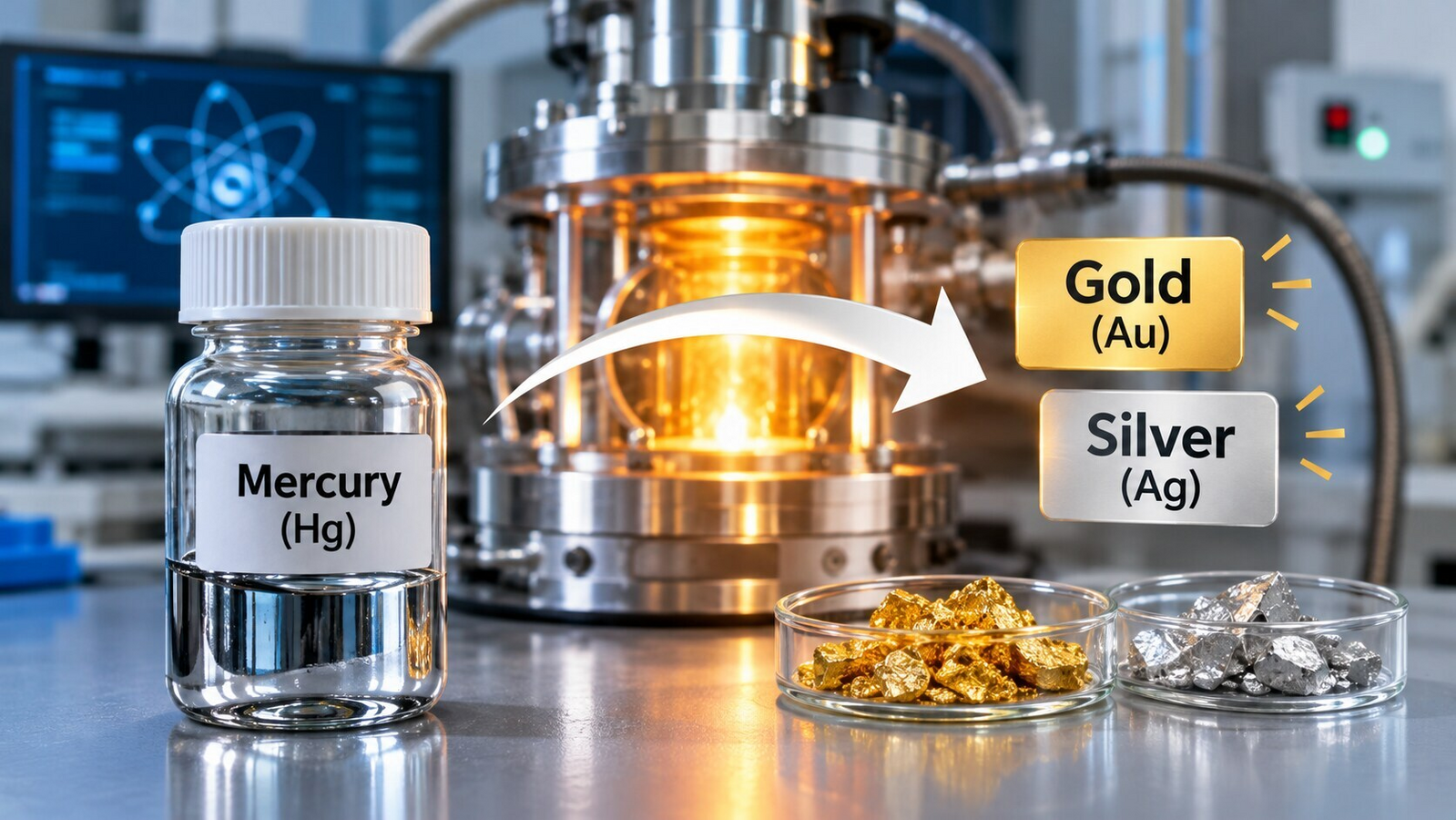
A Bengaluru-based inventor, Rajah Vijay Kumar, has secured an Indian patent for a process he claims can transform ordinary elements into precious metals such as gold and silver. Kumar, director and chief scientific officer of the Scalene Energy Research Institute, calls the technology Gravitoradiophysical Nuclear Transmutation (GNT). The patent was filed in November 2017 and granted in 2025.
According to reports in The Economic Times and The Times of India, laboratory tests on mercury samples processed using the technology detected traces of gold at 1.91 and 2.3 milligrams per litre, and silver at 11 milligrams per litre in one sample. Mercury content reportedly fell from 33.45 grams to 8.67 grams after treatment. The samples were examined using Inductively Coupled Plasma Atomic Emission Spectroscopy (ICP-AES).
The inventor says the two-stage process uses specially generated frequencies to break chemical bonds and separate elements, followed by an element-specific frequency applied inside a reactor called the Boom Tube. The findings, however, do not establish that mercury was converted into gold, as ICP-AES cannot show how an element was produced or whether it was already present as an impurity. Independent scientific testing is still needed to verify the claim.
Converting mercury into gold would require a nuclear reaction, since gold has 79 protons and mercury has 80. The patent and reported laboratory findings should not be treated as proof that the technology can commercially produce gold or silver; its working mechanism, reliability and potential for large-scale use still need to be established.