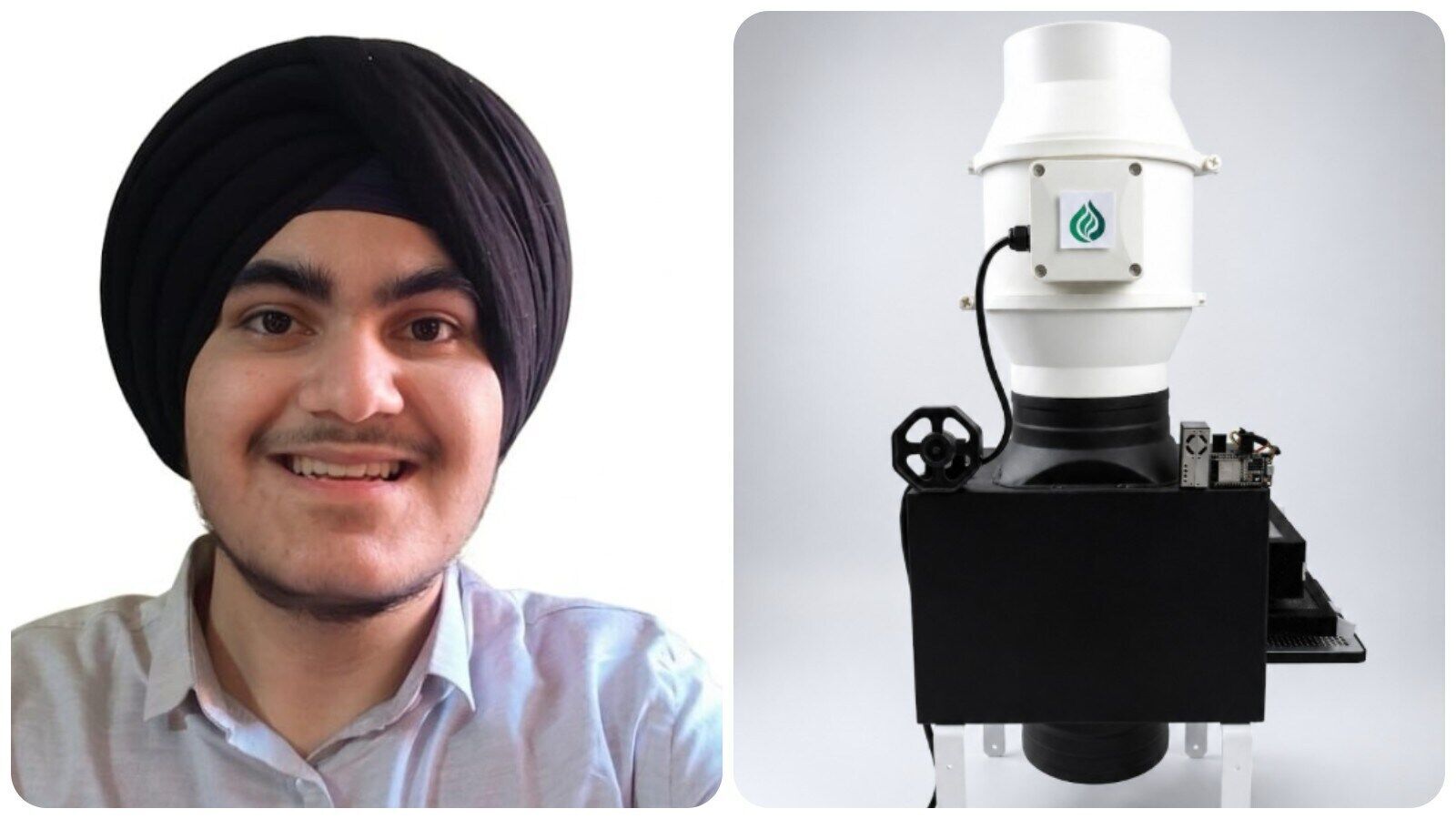
Tanjot Singh, a Class 11 student at Delhi Public School, RK Puram, has developed a bio-based alternative to conventional HEPA air-purification filter media using compressed wool felt and electrostatic cotton. His project is among the top 60 national winners at the 12th National Level Exhibition and Project Competition (NLEPC) under the INSPIRE-MANAK programme of the Department of Science and Technology, implemented with the National Innovation Foundation-India.
Singh is the founder of PraaNavya, an initiative focused on climate hardware and deep-tech engineering solutions for cleaner air, which he says is backed by Emergent Ventures US, Antler India and Masters' Union. According to his blog, he dropped out after Grade 10 in 2025-2026 to work full-time on the venture, self-studied Grade 11-12 Physics and Mathematics, built three prototype generations, filed a patent and ran school pilots, before rejoining school as an 11th grader in 2026. He had previously co-founded SES Clean Air.
His innovation, developed through PraaNavya, aims to address Delhi's air pollution crisis and the disposal concerns around synthetic, single-use HEPA filters, which he says are petroleum-based and environmentally costly. The prototype uses a five-stage bio-based filtration stack — triboelectric wool, electrostatic cotton, activated charcoal, polyester and PLA bio-polymer — which Singh claims achieves 99.7 percent PM2.5/PM10 reduction with about 80 percent less plastic waste than conventional HEPA filters, according to reports.
Singh claims the technology is being piloted across two schools and five classrooms, serving over 300 students, with an analysis measuring about 40 percent lower PM levels in situ. He has pitched to more than 30 stakeholders, including venture capital firms, IIT Delhi and the Ministry of Environment and the Government of Delhi, and was selected from over 120,000 startup registrations for a virtual pitch submission at Shark Tank India Season 5, Stage 2.