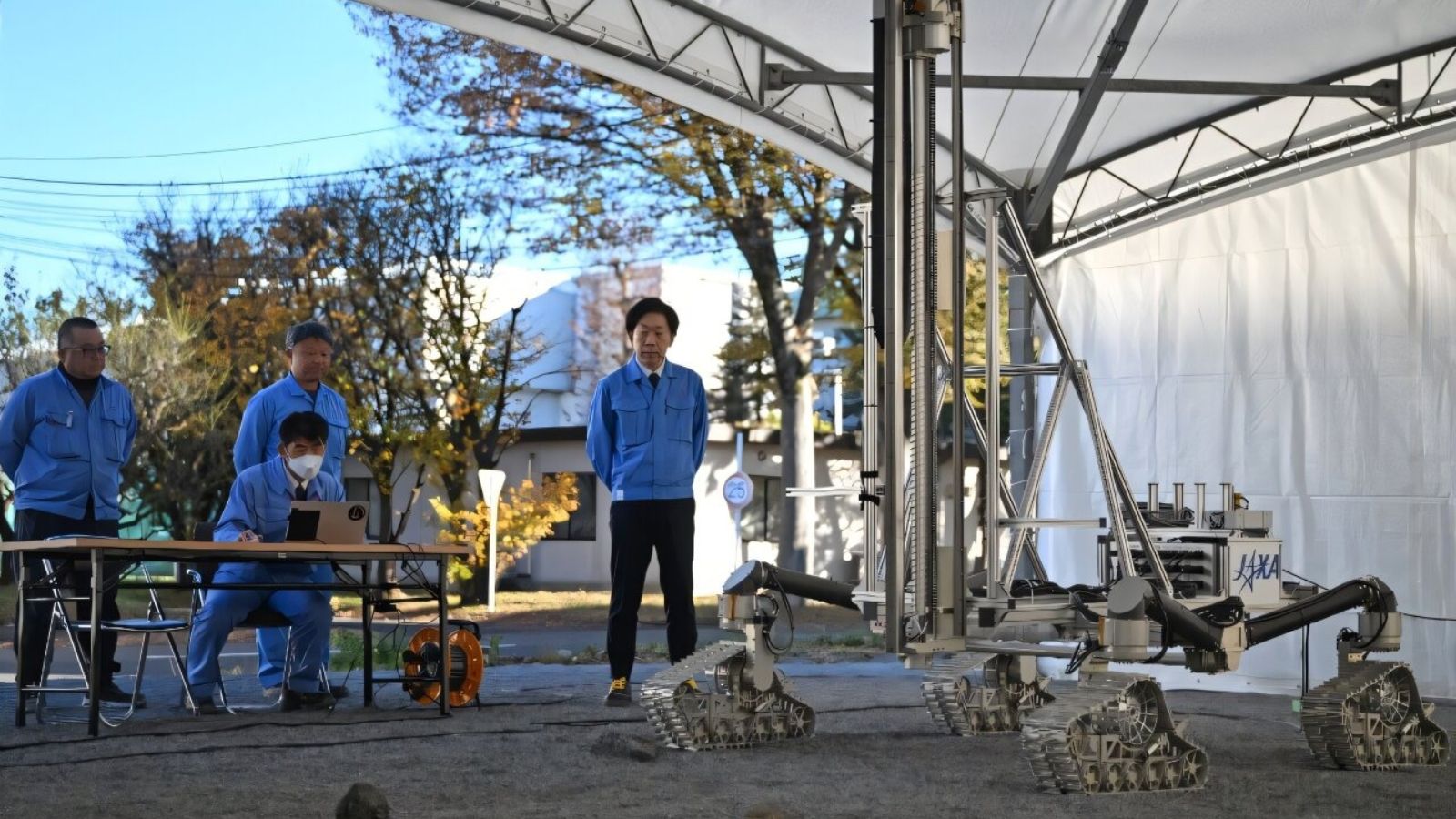
The Japan Aerospace Exploration Agency (JAXA) on Wednesday presented the prototype of the rover for the Chandrayaan-5 mission, described as a major milestone in its first joint lunar exploration venture with the Indian Space Research Organisation (Isro). The rover was unveiled during a media briefing at the Chofu Aerospace Centre in Tokyo.
According to JAXA, the rover weighs around 350 kg and will carry seven scientific instruments. While JAXA is developing the rover, Isro is building the lander module. At the presentation, the JAXA team demonstrated the rover's mobility over simulated uneven lunar terrain using belt-like crawler tracks. Officials said the four-legged crawler, rather than a conventional wheeled vehicle, has its actual flight model in an advanced stage of testing.
Once on the Moon, the rover will explore areas around the landing site along a pre-planned path mapped jointly by Isro and JAXA for scientific operations, measurements and battery recharging. It will study surface temperatures, look for geological clues, and examine the presence and distribution of water and water ice on the surface and below ground. The mission involves two tiers of exploration: coarse observations to survey the terrain and identify drilling spots, and fine observations involving extraction and analysis of lunar regolith samples from depths of up to 1.5 metres.
Also known as the Lunar Polar Exploration (LUPEX) mission, Chandrayaan-5 is scheduled to lift off in 2028 aboard Japan's H3 rocket from the Tanegashima Space Centre. Weighing roughly 6.5 tonnes at launch, the mission has a nominal lifespan of three and a half months after landing, extendable up to one year. Scientific teams from both agencies met in Bengaluru in July to review progress. Of the 11 payloads on LUPEX, the European Space Agency is developing a mass spectrometer, while Nasa is contributing neutron spectrometers to aid in detecting subsurface hydrogen and water ice.