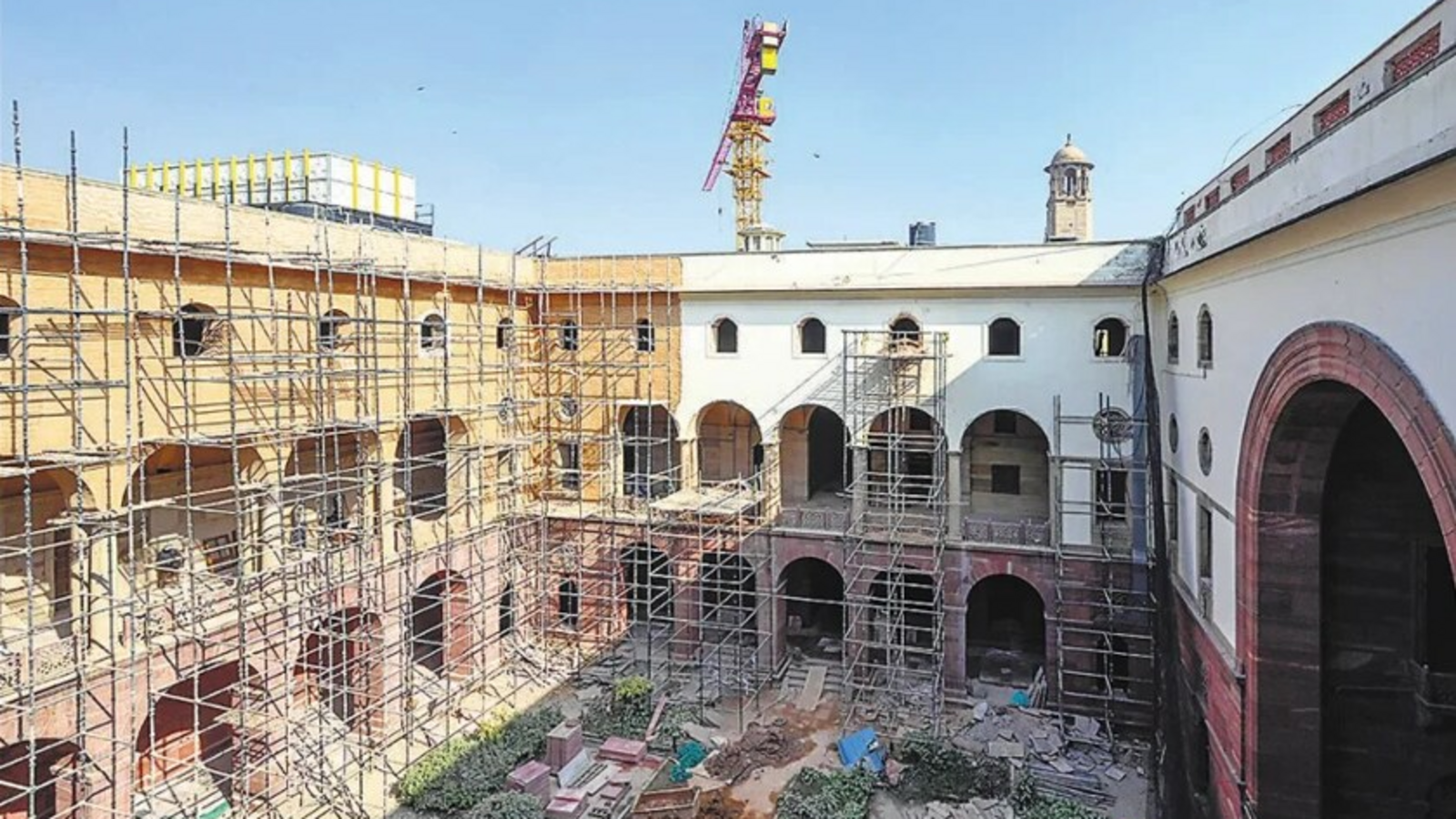
A section of Delhi's North Block, which once housed key ministries including Home and Finance, will open to the public towards the end of 2027 as part of the government's Yuge Yugeen Bharat Museum. Its first gallery will display up to 1,000 objects tracing India's traditions of adornment, the first of seven themed galleries planned across the North and South Blocks. The larger museum is expected to display 1.8 million objects, with other themes including Mathematics and Astronomy, Architecture and Cityscapes, Healing Systems and Medicine, Beliefs and Spirituality, Languages and Scripts, and Bharat Connects - Trade and Ideas.
Exhibits will be drawn from government museums across the country, including the Kolkata-based Indian Museum, the country's oldest museum. For the Adornment gallery, the Indian Museum has sent rare works including a Mauryan period stone sculpture of the Earth goddess known as the Lajja Gauri figure, and a 14th century statue of Darpanika (Surasundari) from the Eastern Ganga Dynasty from Puri, Odisha. The Victoria Memorial Hall in Kolkata will send an early 20th century watercolour by Abanindranath Tagore depicting Vasantasena from Mrichhakatika, while a sculpture of the same character from the National Museum collection will also be displayed, along with Saundarya Lahiri, a Sanskrit literary work attributed to Adi Shankaracharya.
Union culture secretary Vivek Aggarwal described the exhibits, which include inscriptions, manuscripts, sculptures, paintings and archaeological material, as "hard evidence" of India's civilisational legacy. He said the Adornment gallery would show the sophistication of Indian civilisation and the evolution of how people presented themselves through jewellery, dresses, head gears, tattoos and craft, and would explore how adornment and "shringar" evolved over time. The section will include an orientation room and food and beverage facilities, a ministry official said.
Built between 1912 and 1929 by architect Herbert Baker as part of the seat of imperial power in British India, North Block is undergoing extensive restoration and adaptive reuse, with wooden window panes removed, door frames treated and polished, floors replaced, walls given lime plaster and seepage repairs under way. Aggarwal said the restoration involves minimal intervention even though the building is not a designated heritage structure, and that 70-80% of the 78,000-square-metre built-up area in the section being developed will become gallery space, compared with an estimated 45-50% earlier used for offices. The plan was developed by School of Planning and Architecture, Bhopal with assistance from the Archaeological Survey of India and heritage experts, while Los Angeles-based architect and museographic designer Kulapat Yantrasast leads the team repurposing the building. Announced by Prime Minister Narendra Modi on May 18, 2023, the project received approval from the Cabinet Committee on Economic Affairs earlier this month, with a total estimated cost of ₹3,230 crore, and is part of the Central Vista redevelopment project.