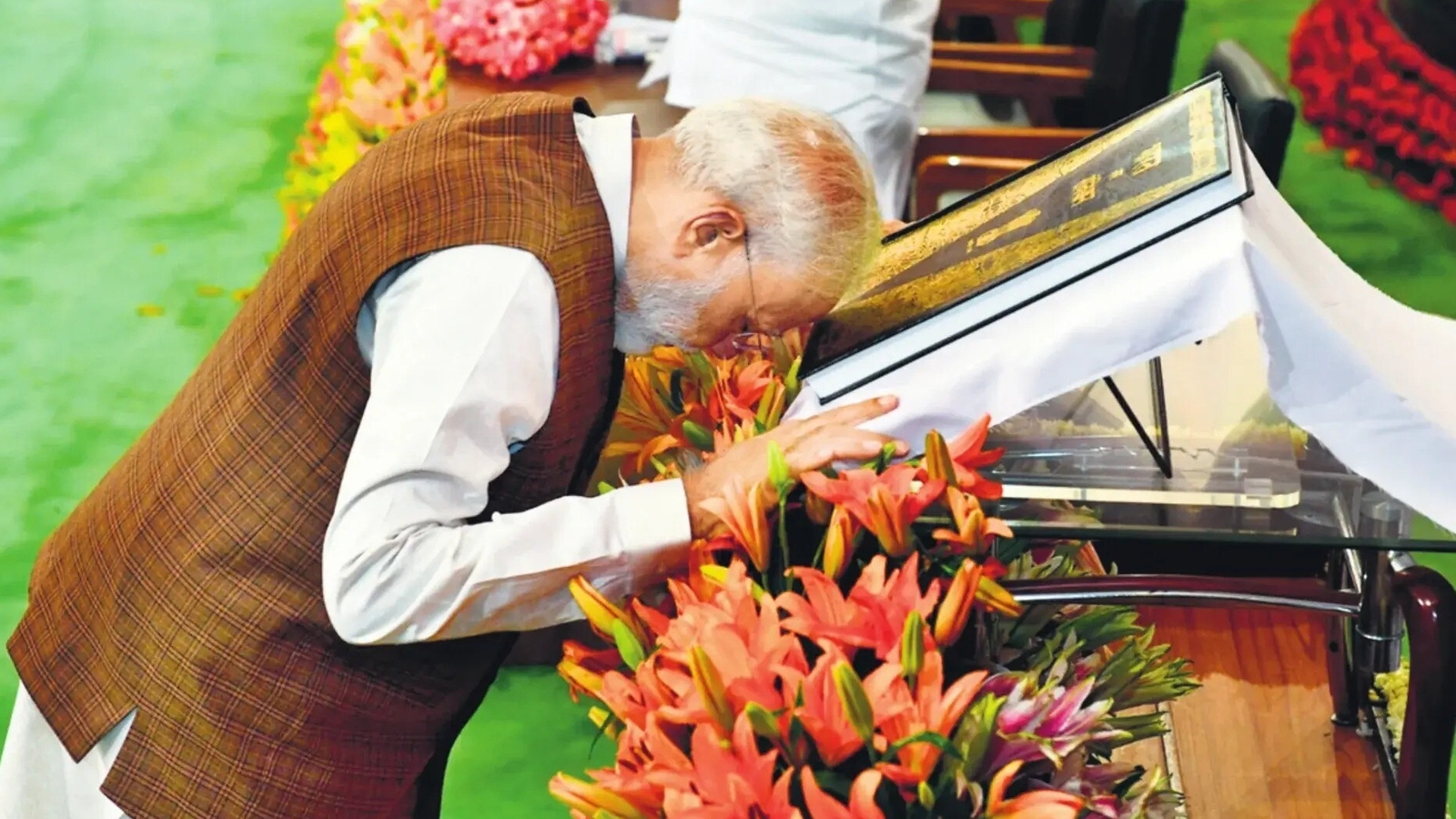
Prime Minister Narendra Modi on Wednesday said the Constitution must resonate far beyond Parliament and the courts, stressing the need to deepen its connection with the collective consciousness of the people, especially the youth. In a post marking Constitution Day, he recalled the adoption of the Constitution by the Constituent Assembly on 26 November 1949 and paid tribute to Dr Rajendra Prasad, Dr Babasaheb Ambedkar and every member of the Assembly.
Modi said the Constituent Assembly's greatness lay in drawing extensively from India's rich traditions and civilisational wisdom while framing a modern Constitution. Noting that the country is home to numerous faiths, languages, customs and schools of thought, he said his government's endeavour has been to strengthen the spirit of unity essential to India's future, and that it was for this reason that the government decided over a decade ago to mark 26 November as Constitution Day.
Describing the Constitution as an inseparable part of his own life journey, Modi said it was due to the Constitution that circumstances of birth no longer determine the limits of one's future. He cited the World Bank report highlighting that nearly 50 crore Indians have moved out of poverty, and linked schemes such as PM Awas Yojana, Ujjwala Yojana, Ayushman Bharat, MUDRA and PM-SVANidhi, as well as digital platforms like UPI, to the realisation of the Constitution's promise of dignity, equality and social and economic justice.
The Prime Minister also referred to the 101st, 102nd and 103rd Amendments and said an updated version of the Constitution is now available in all 22 languages of the Eighth Schedule for the first time since 1950. He said the Bharatiya Nyaya Sanhita seeks to shift the criminal justice system from a colonial emphasis on punishment to a citizen-centric pursuit of justice, and that the spirit of Kartavya has found expression in mass movements from Swachh Bharat to water conservation. He also said there have been occasions when those entrusted with upholding the Constitution chose to weaken it, and that the First Amendment of 1951, brought by a government that was not popularly elected, restricted fundamental freedoms.