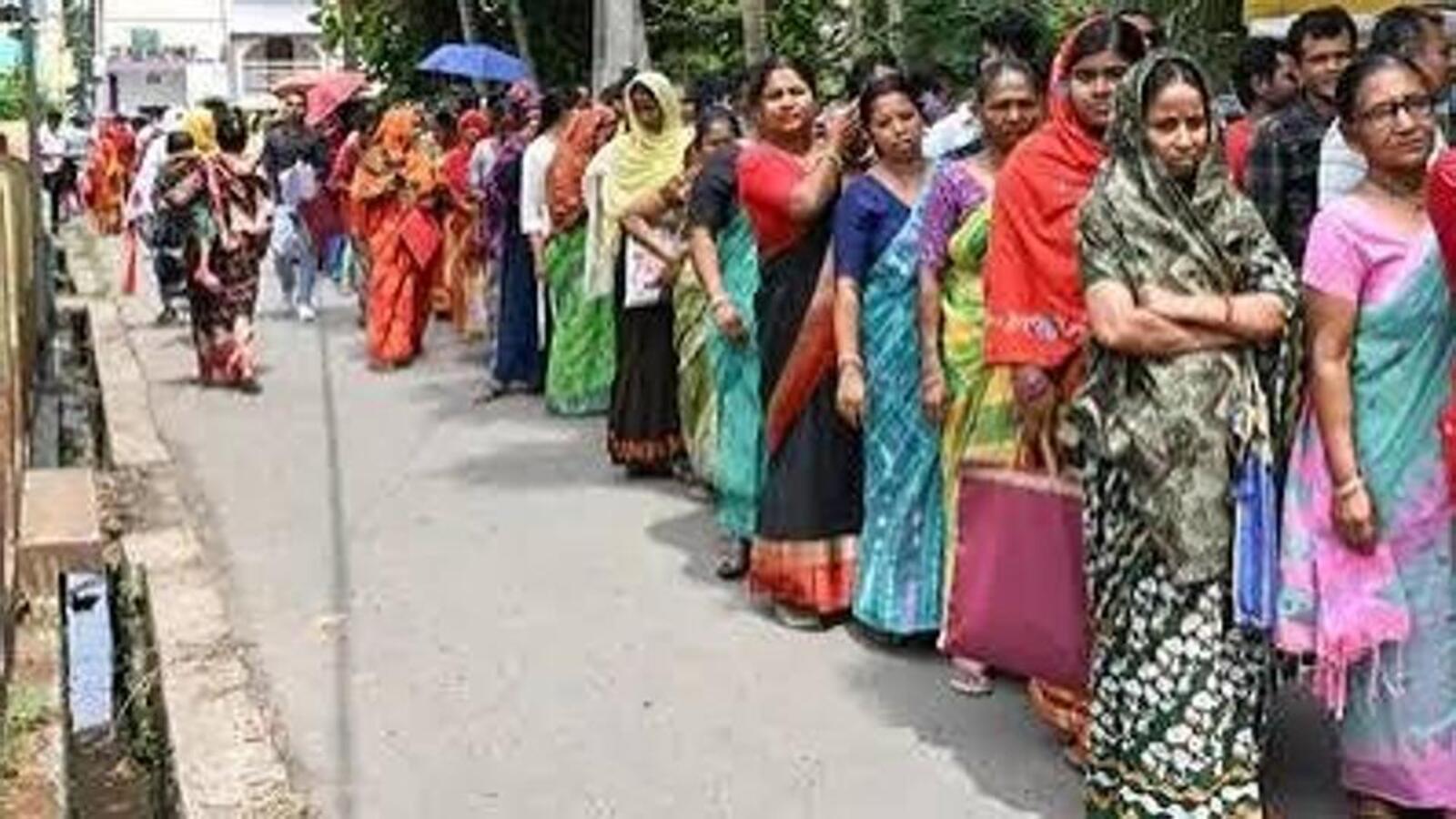
The Supreme Court on Monday directed appellate tribunals hearing challenges arising from the special intensive revision (SIR) of electoral rolls in West Bengal to give priority to appeals filed by voters whose names have been deleted, while deferring for now appeals seeking the exclusion of voters whose names were included. A bench comprising Chief Justice of India Surya Kant and justices Joymalya Bagchi and V Mohana ordered the tribunals to segregate the appeals into two categories, observing that challenges by deleted voters carried greater urgency as their right to vote was directly at stake. Appeals by deleted voters from constituencies within Kolkata Municipal Corporation limits are to be given priority in view of the upcoming municipal elections.
The directions come amid a mounting backlog before the 19 appellate tribunals constituted to adjudicate disputes from the SIR exercise. Of the 38.31 lakh appeals filed so far, 22.21 lakh are by voters seeking restoration of their deleted names, while 16.10 lakh challenge the inclusion of certain voters. Advocate Prashant Bhushan, appearing for petitioners, pointed out that only a little over one lakh appeals had been decided so far, and that 93% of those decided had gone in favour of deleted voters. He also highlighted that more than two lakh voters from the Kolkata municipal area had been excluded and their appeals remained pending.
The court directed the Election Commission of India, in consultation with the chief justice of the Calcutta high court, to increase the strength of the appellate tribunals for expeditious disposal of cases, and to identify alternative premises at different locations in Kolkata for their functioning. The bench issued the directions after hearing submissions on the 16.10 lakh appeals filed by officials from the office of the West Bengal chief electoral officer challenging the inclusion of names in the electoral rolls.
Senior advocate Gopal Sankaranarayanan questioned the legal basis for these appeals, arguing that the CEO had no authority to institute challenges in the name of the ECI against decisions taken by electoral registration officers. He submitted that under Rule 23 of the relevant electoral rules, appeals against decisions of electoral registration officers under Rules 20, 21 and 22A could be filed before an officer designated by the ECI, making the filing of appeals by the poll panel's own authorities legally questionable. The issue had also figured in an affidavit filed by the ECI before the Supreme Court in October, in which the poll panel maintained that the appeals had been filed by officers of the West Bengal CEO's office in their statutory capacity under the Representation of the People Act, 1950, and that the matters had not been brought before the commission. The affidavit, however, did not identify any individual who authorised the filing of the 16.10 lakh appeals, an issue flagged in a separate petition questioning the manner in which decisions concerning the SIR exercise were taken.