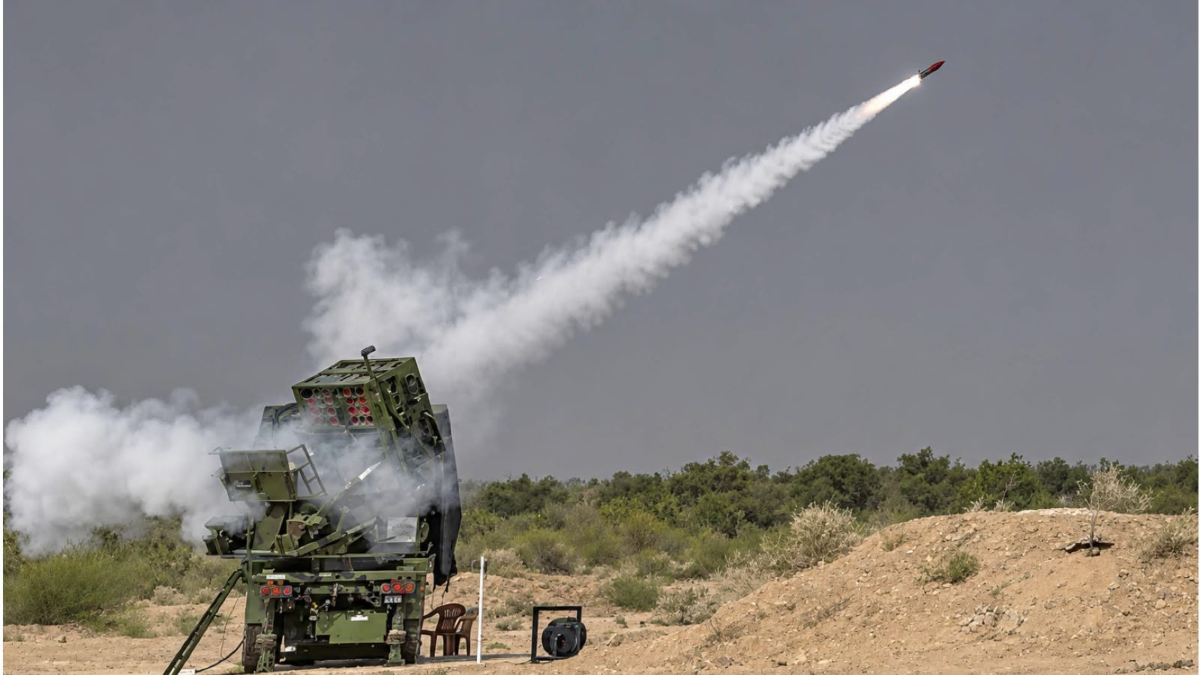
India has completed development trials of Bhargavastra, its first indigenously designed and developed two-layer, vehicle-mounted counter-swarm drone system, at the Pokhran field firing ranges in Rajasthan. The trials, conducted from November 20 to 24, were carried out by Solar Defence and Aerospace Limited (SDAL), which says the system is now ready for prototype demonstration in its deliverable configuration.
According to SDAL, Bhargavastra combines air defence rockets with guided micro-missiles to detect, track and engage drone swarms. Version-I uses air defence rockets, while Version-II adds guided micro-missiles with autonomous guidance and infrared seekers. The system's detection and tracking network includes radio-frequency detectors, surveillance radars and electro-optical systems, coordinated through an integrated C4I command system. The launcher capacity is 64 tubes for rockets in Version-I and 64 micro-missiles in Version-II, with the complete system deployed across three Army-inducted vehicles.
The Indian Army's requirement for a vehicle-mounted counter-swarm drone system was issued through a Ministry of Defence (Defence Production) PSO on July 9, 2024, under the Make II (Buy Indian IDDM) category, with a stipulated project completion date of March 31, 2027. SDAL says it went beyond the initial requirement by independently developing Version-II, and that the system, including its software, rockets and micro-missiles, was developed in India with the company holding complete intellectual property rights.
During the trials, the system conducted multiple firings of both rockets and micro-missiles. According to SDAL, rockets fired at actual swarm-drone targets detected and tracked by the system's sensors and C4I network struck their designated points, and separate trials of the micro-missiles' guidance and terminal homing capabilities against drones were successful. Further optimisation and trials are planned to improve engagement and kill probability.