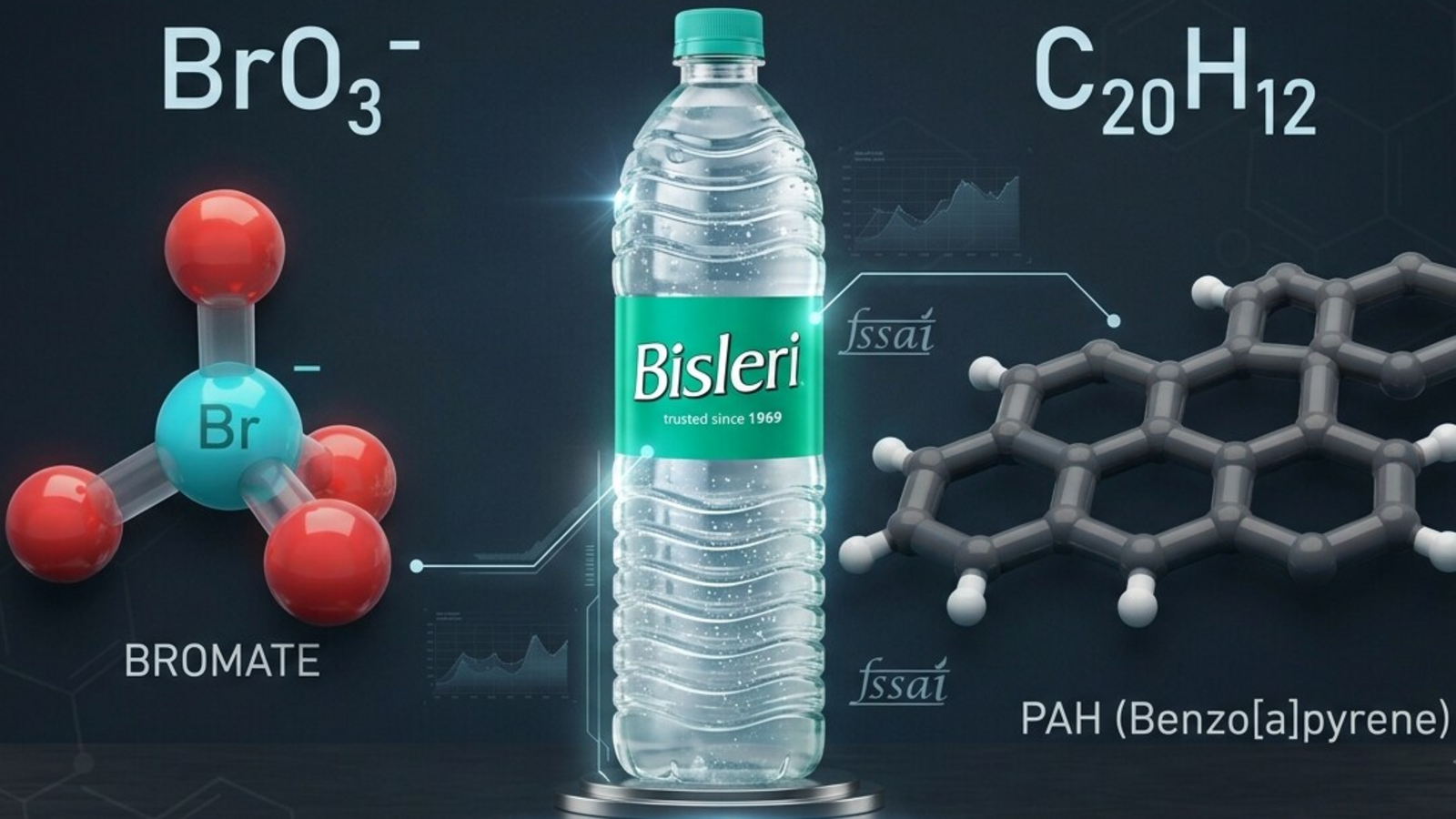
The Food Safety and Standards Authority of India (FSSAI) has sanctioned prosecution against packaged drinking water manufacturer Bisleri International after one of its samples was declared "unsafe" in laboratory testing, even as the company disputed the findings. The row centres on the presence of bromate and polynuclear aromatic hydrocarbons (PAHs) in the sample.
According to the World Health Organisation, prolonged exposure to certain chemical contaminants in drinking water, including bromate and some PAHs, may pose health risks such as potential kidney damage and an increased risk of cancer. Bromate, classified by the International Agency for Research on Cancer as "possibly carcinogenic to humans", can form during disinfection when ozone reacts with naturally occurring bromide ions; the WHO has set a provisional guideline of 10 micrograms per litre. PAHs, formed mainly through incomplete combustion of organic materials, can enter water through coal-tar coatings in distribution pipes, and the WHO prescribes a guideline value of 0.7 micrograms per litre for benzo[a]pyrene, an indicator of PAH contamination.
The dispute relates to a sample collected by FSSAI from Bisleri's Goa manufacturing facility on September 30, 2025. According to the company, of six samples collected, five initially met standards, while the sixth recorded bromate at 12 micrograms per litre against the prescribed limit of 10. Following Bisleri's appeal dated November 22, 2025, FSSAI sent the sample to a referral laboratory, which the company said found bromate within limits but separately flagged PAHs. Bisleri said an independent test at an FSSAI-approved laboratory also found bromate within limits, and it submitted the results to FSSAI's Western Regional Office on February 2.
Bisleri said it received no further communication from FSSAI and understood the matter to be closed, maintaining it had not received any formal notice. FSSAI, however, announced it had sanctioned prosecution after finding the sample "unsafe".